Showing posts with label Land Rover. Show all posts

Monday, December 5, 2022

Gift for the Holidays--Africa Inspiration


Are you or someone you know planning a trip to Africa? My series of three books set in Africa could be just the inspiration you need. 
 
Safari Jema, A Journey of Love and Adventure from Casablanca to Cape Town

My Life with Ndoto, Exploring Africa in a Forty Year Old Land Rover

The Dancing Bridge of Kamunjoma
 
All are available at Amazon in print and kindle version, or order from your favorite bookstore.  
Safari Jema is also available on Audible.

Monday, June 28, 2021

Adventures of Green Eyes: Guns, Germs, and Keels

                                                        GUNS, GERMS, AND KEELS


      GUNS

     What do guns have to do with the Great Loop? Nothing. Except when there is a need to rent a car to run errands, sight see, or visit friends. Depending where you are when you need to rent a car, guns can affect your day. The first time was when we rented a car from Enterprise in Tennessee. 

     The great thing about Enterprise is that they will pick you up at the marina and take you to the office. On this occasion, Steven delivered us to the rental office then offered us a free upgrade from the cheapo economy option we had reserved. Steven was a recent graduate of Bible school who, upon being offered a job with Enterprise, broke up with his hometown girlfriend and moved to Chattanooga, Tennessee. He told us all about it during the drive to the office.

     "How would you like to have a convertible Camaro for the day?" he asked with a good-deed glow in his eyes. 

     Knowing this would probably be my only chance to have a free upgrade to a convertible Camaro in my life, I said, "Would I! Would I!" while doing my Happy Dance. But in Tennessee's humidity, it was more of a Happy Shuffle.

    Steven smiled. "I'll be right back. I just need to run it through the wash." As Steven disappeared through a side door, I whispered to Scott, "See? You always complain that I talk to everyone. But you know I enjoy connecting with people, right?" 

"Uh huh," said Scott. "You connected so much for such a short car ride."

      "Well, I think it made Steven feel good that I, a total stranger, affirmed his decision to break up with Beth and move away from his family, friends, and all he holds dear to begin a career with Enterprise Rent A Car in another state...." Steven returned and Scott rolled his eyes at me. 

     "I'm so sorry. I can't give you that car," Steven said with disappointment. "We found a gun in it so now we have to lock the car and call the police. Let's see... How about a small truck?"

     Had we heard right? "A GUN? Someone forgot to take their GUN out of their rental car?" Scott asked in disbelief.

     Steven chuckled. "I know, right? I would definitely remember if I had my gun with me. You wouldn't believe how much it happens. So, how about that truck?"

     "But, what if you hadn't found it?" I asked. "What if I found it while reclining the seat, or putting a map in the glove box, or wherever it is that people keep guns in a rental car? Or what if I didn't find it and then you found it when we returned the car? Then you'd think it was OUR GUN."

     "We search the cars thoroughly when we clean them. Like I said, it happens a lot."

     We took the truck, which was not one iota as much fun as a convertible Camaro.

     (When I told my Brooklyn comedy-writer niece Clare this story she responded, "Leave the gun, take the Camaro" which really made me wish I'd thought of that.)

     The second time it happened was in Alabama. When we arrived at the Enterprise desk, we told the story about the time that, but for a gun, I would have had a Camaro for a day. 

     "Oh my gosh! Isn't it just the weirdest thing?" Blond-haired, blue-eyed Kelly exclaimed. "I just moved here from San Diego, California and it was one of the first things they taught us in training. About the protocol when a gun is found, I mean.  It's mind boggling how many times we find a gun in the car when it's returned. I mean, I think I would remember if I had a GUN."

    GERMS

Tris with her niece Clare O'Kane

     Germs, of course, refers to Covid. Yes, we are still cruising in the time of Covid. But compared to last summer, since vaccinations have begun, things are a lot different on the Great Loop. We hardly see anyone wearing a mask. In New Jersey however, folks are still in the thick of it and mostly everyone masks up. I even got yelled at by a very grouchy harbormaster when I sat on a lounge chair next to the marina pool waiting for my laundry to finish drying in Cape May. 

     "You can't sit there. It's because of the Covid. We don't have time to disinfect the chairs after someone sits on them, ya know." I could tell he was tired. We're all tired. None of us has the energy to use one more damn Lysol Disinfecting Wipe on one more damn surface. But there is something other than Covid cleaning fatigue going on. The often uttered promises, "Boy, when I'm vaccinated, I'm going to hug EVERYONE. I'm going to see all my friends and family and all my friends' families too! I'm going to look up my old high school teachers and HUG them. I'm going to eat out every night in a RESTAURANT. I'm going to go to a BAR!" are falling a little flat. Gatherings seem subdued. Some people even seem a bit agoraphobic. We are not the social animals we were 18 months ago. Things have changed. We've changed. We've been through this thing, this global collective experience, and we should be changed by it. There's been lockdown. And loss. From my own unscientific observations of marinas and towns within a one mile walking distance of whichever slip Green Eyes is in for the night, people are taking the social hour in ten minute increments. Me too. I used to love nothing better than a party. Now, even the thought of socializing exhausts me. Talking makes me tired. Rearranging my face to affirm, "I am very interested in your story of how you dented your prop (your windy anchorage experience, the good Chinese buffet you found...") after a year of rolling out of bed and onto the couch to pet the cat and having no real need or energy in making my face or hair look polite, well, you try it. It's not that easy to go from lockdown to loquacious. I like staying home, be it ashore or afloat. I most love being with two beings; Scott and Pika. And my family. And friends. And Elephants. And well okay I pretty much love all beings. But quiet crosswords and kitties make me happy.


I've forgotten how to "pace myself." We recently attended a renowned annual three-day Looper Event which is an excuse for other folks doing the Great Loop to get together to drink and share stories. This particular multi day Looper Event was a Pig Roast at Donovan's Shady Harbor Marina in New Baltimore New York.  The pre-parties that led up to the main event -- bottomless mimosas with the Looper Ladies, happy hours, bocce ball competitions, rum and vodka tasting, boat tours, boat blessings-- were so exhausting and fun I couldn't even make it to the main event. No pork for me! I know I'll eventually get back into the swing of things. But it won't be like it was. And that's okay. 

Blessing of the boats.

     KEELS

     Keels. Boat keels. Although, officially, we have a hull, not a keel. Sailboats have keels. But I wanted to keep it alliterative, borrowing the title of this blog post from a book we are listening to as we cruise, Guns, Germs, and Steel by Jared Diamond, which is an excellent book about everything or, "... the theory of geographic determinism, the idea that the differences between societies and societal development arise primarily from geographical causes." And no, we don't fall asleep at the helm while listening. Anyway, about keels. What I most like about keels, or hulls, is what's written on them. Ours says Green Eyes. We did not pick the name. But it suits us and it suits the boat well.


Unfortunately, the home port below the name reads Sabine Pass, Texas, which is where we bought the boat, but which does not suit us. We have our new home port decal, Santa Cruz, California, (chosen because it's the closest harbor to our home and it makes us feel like we are on a surfin' safari.) But getting the old letters off involves a heat gun and patience and last time I looked, neither of these can be found in the tool drawer on board. Did I say drawer? My husband, the Captain, sees our entire boat as a small tool shed. I still see it as a cozy cottage or a
HDTV Tiny House. But there's always a screwdriver blocking my view. Back to keels. I like what's written on boats because it says something about the occupants. The word "knot" is used a lot. Knot on Call is owned by a retired doctor. Knot in a Hurry is owned by a couple who just finished the Loop in record time. Others are: Knot Too Late, Knot Working, Knot Bad, Knot Real, Moor Often Than Knot, Knot Shore, Knot For Sail, Why Knot, Knot Guilty... the list goes on. Or knot. Other whimsical names are Sea Senor, Cirrhosis of the River, Water You Lookin' At? and The Codfather. ( See how I fit two Godfather references in one post?)

     Except for that little El Toro sailboat we had for awhile that my niece Briget and I named Emilio, Scott and I have never named, or renamed a boat. We named our Land Rover, which lives in Africa, Ndoto because I am so annoyingly transparent. It's Swahili for Dream.


The first boat we had that we didn't name was a 40' Wharram catamaran. We owned it back in the early '80s when catamarans were considered weird. Her name when we bought her was Different Drummer, which suited us to a T. With Scott's brother Brian, Scott and I sailed her from Santa Cruz to Hawaii in 21-days, in younger and skinnier times. Like Green Eyes and Ndoto, she was simple, yet dependable, just the way we like my surroundings. 


And that's the news from the crew of Green Eyes, the 26' Nordic Tug that suits us three to a T. 


Friday, August 25, 2017

Self Imposed Isolation and Seclusion in a Wee Ville.


You know that phrase, "I'm one of those people who..."?  Well, I am one of those people who always wanted to live on a farm, with no distractions other than dogs, cats, and ducks. To do nothing but read, write, and pet the farm dogs, cats, and ducks. (No success on the ducks yet. And one dog, with the cone of shame, is hard to pet.) I'm one of those people who, at this moment, is actually doing what I've always wanted to do.

I'm in rural France, working on three hundred and fifty pages of stories about living in, sleeping on, and driving around Africa in a 44-year-old Land Rover named Dream.
As I edit "Oh Great, the War is Starting and I'm Naked", or "Stairway to Heaven, Ascent to Rwanda", or "The Rainy Season Red Lagoon Roads of Zambia" I can hardly believe we did these things, or that I would gladly do them again. 

A little over three weeks ago, Scott and I flew from South Africa to Paris. We parted ways at Charles de Gaulle airport because Scott is one of those people who has always wanted to hike the John Muir Trail in California. One of his buddies was lucky enough to get a permit to hike it this summer and invited Scott to blister along.
"But what will you do while I hike the JMT?" asked Scott when I told him of course he should go. 
"Oh, don't worry about me!" I said. "I'm one of those people who can always find something to do."
And it's true. But it's kind of easy when you're one of those people who likes peace and quiet, and books and animals. 


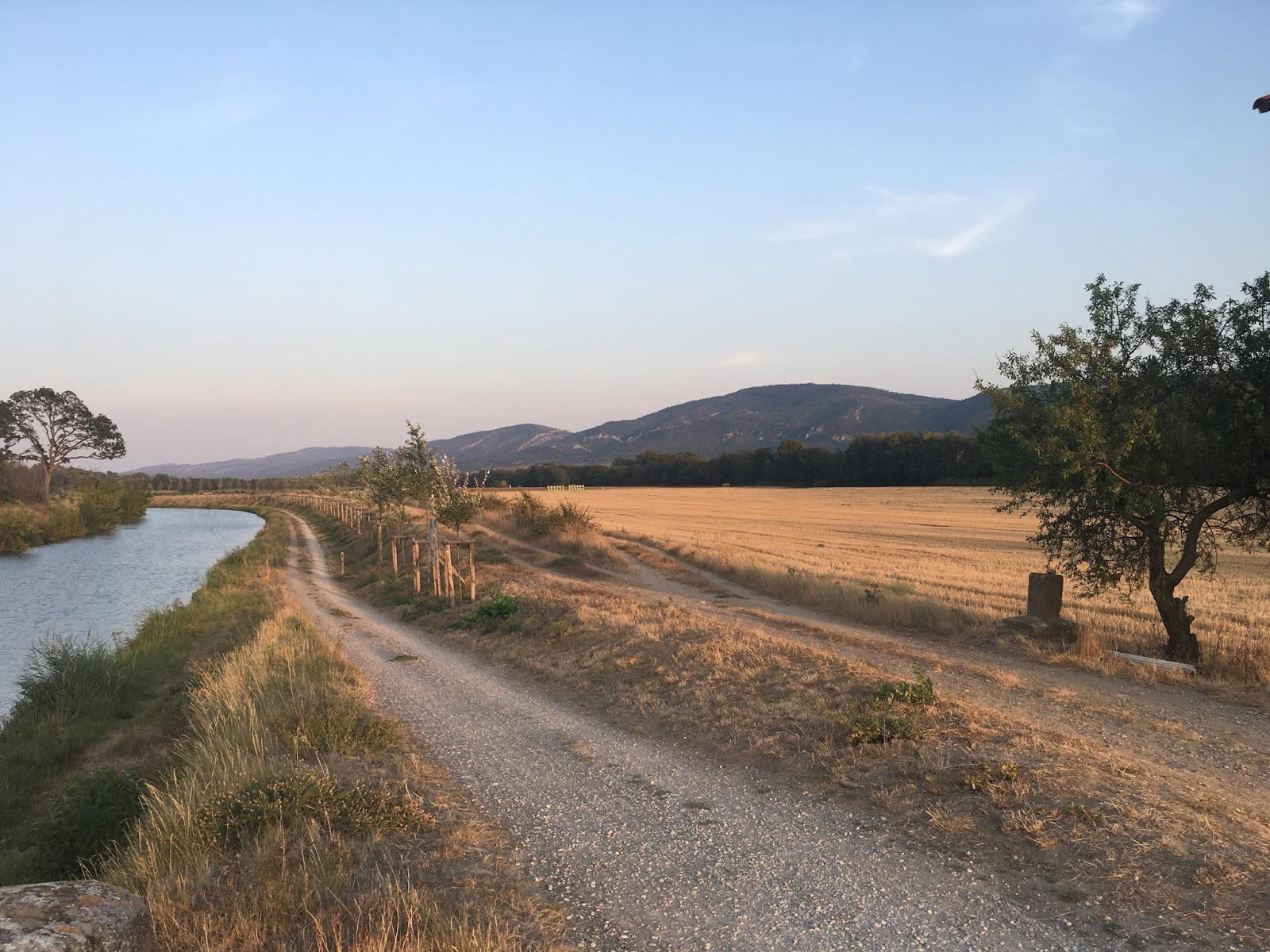
So, I found this place to stay in rural France. It's a renovated 300 year old farmhouse and stables. (I really do like old things.) It sits on the Canal du Midi, which is PERFECT because Scott and I are two of those people who want, some day, to buy a canal boat (picture the Ndoto of canal boats) and cruise this exact canal. I'm doing lots of research. I especially like the old one below that needs work.


The farm is close enough to a small town that I can walk or ride a bike to get groceries. But I have to want it bad, because it's not really that close and there's usually a head wind both ways. For efficiency sake, I had three croissants my first day here, and I only buy what I can carry in a day pack. Baguettes don't weigh much. Avocados and nectarines are HEAVY. I eat simply and I take a lot of walks


It's a working farm, so there's lots of activity, especially now during the vendange, the grape harvest. The grapes are harvested at night when temperatures are right for picking, so there are massive plucking machines, trucks, and flatbeds, which rumble down the narrow road that runs between the original farmhouse and the stables, at all hours of day and night. Oh, and it's hunting season (wild boar, mostly) so there are sudden blasts of gunfire and excited shouting from the fields nearby, also at random hours of day or night. They say, every year some innocent cyclist, or walker, or author on a quest for a croissant, gets accidentally shot by a nearsighted hunter, "Oo la la! Mon dieu! Dommage. Madam, Don't you know carbs are bad for you?"
So I stick to the canal tow path and wear something not bristly so I don't resemble une sanglier.


There are lots of boats cruising up and down the Canal du Midi in August. Big boats, little boats, and boats rented from a company called Le Boat. Everyone seems to be having fun, probably because they don't have to ride their bikes or walk far to get a croissant. They just dock in any little village and voila!, there's baguettes aplenty within a few paces, because, after all, this is France and no one is expected to partake of a meal without bread.


                I try not to get distracted by the farm animals but they are so... distracting! 


There's one other distraction on the farm. The farmer's wife sells their vin out the farmhouse window for less than $5 a bottle. And it is bon.

As you can see, I'm learning some French. The only words and phrases I knew when I arrived were, Je suis fatigue (I am tired, because I learn how to say that in every country I visit), poisson (fish, because my niece Clare learned it in pre-school and taught it to me when she was four and I never forgot it), velo (bike, because that's how I get to croissants), and croissant (croissant). 


So far, I have stayed in a renovated flat in the original farmhouse, and in (because I never say neigh) a renovated stable. I found the farmhouse flat very charming. Mostly because on the day I arrived, I threw open the windows that overlook the canal, and the first thing I saw was an old Land Rover! This was the day after we had put our own beloved Land Rover, Ndoto, in storage in Hoedspruit, South Africa, so I took that as a massive dose of synchronicity and serendipity. The week I stayed there I wrote furiously about My Life with Ndoto (title of Book II by the way).


Then I moved across the lane to the renovated stable. I love the stable. The kitchen and bathroom are downstairs, and the bedroom, writing room, and private patio are upstairs. But, I can't see the farmer's car, the Land Rover, so I have not been as productive. Tomorrow I move back to the flat with the Land Rover view so I've sharpened my pencils, so to speak.

In a week, Scott will join me here, after he finishes the hike and I CANNOT WAIT. Number one, I'm one of those people who miss their husbands. Number two, he can ride a bike faster than I can (to get to croissants). And number three, we have lots more adventuring to do together before we return home in November. 

There's only eight or ten homes in this wee ville. 
I can buy wine and vegetables from the farmer. 
Everyone is tres gentil, very kind. 
I feel at home.

It is such a gift to be here. 


-Tris
Millepetit France


Monday, August 21, 2017

In the Beginning, My Life with Ndoto, Around Africa in a Forty Year Old Land Rover


If You are Willing to Live with Snakes and Hippos, Dreams do Come True


     “Remember,” Scott said seriously, “don’t get too excited about it. The asking price is way too high. Find flaws. Whatever you do, don’t say you love it.”

     “I know, I know. I’ll keep quiet while you do the negotiating,” I promised as we climbed out of Ndoto and greeted the man who had placed the For Sale ad. Then, I set eyes on the tent.

     “Oh my. It’s perfect!” I said aloud. “I love it.”

     Scott rolled his eyes and said through pursed lips, “Geez, Tris.”

     “I heard your old Landy coming up the road,” said the South African with the smug smile of one who owns a Toyota Land Cruiser. Or maybe he was smiling because I’d just clinched the deal for him. “Series III, right? They sure aren’t stealthy.”

     “No. But they’re strong.” I said defensively.

     “Of course they are.”

     As soon as he unzipped the rain fly, I climbed up the ladder and into the tent. I could hardly contain my satisfaction. It was the rooftop tent of my dreams.

     Scott forced a cough in order to muffle the sounds of contentment coming from inside the tent. I hung my head out the opening to watch Scott do what he does best while he circled what might be our bedroom for a year. He turned to the owner of the only second-hand Hannibal rooftop tent for sale in a five hundred kilometer radius and went into bargaining mode.

     “I don’t know if this one will work for us.” Scott said, pulling on his ear lobe. He did another lap. God, the man has patience. I flopped on my back and stretched out in the idyllic little tent. I sighed, imagining our first night sleeping in it.

     “I would have to modify the rack on our Landy to make the tent fit.” Scott continued, trying to talk over my bliss. “Why are you selling?” he added. Hey, yeah, why would someone sell such a perfect tent? I poked my head back out the opening.

     The owner looked at the ground. Then he looked at me and saw that it wouldn’t matter what he said.

     “Well, you see, my wife doesn’t like to have to climb down the ladder at night, you know, when she has to relieve her bladder. She’s afraid of snakes.”

     Wait a minute. Snakes weren’t in my dream. Snakes terrify me almost as much as hippos. After mosquitoes, which cause malaria, hippos are the most dangerous animals in Africa.

     “Plus,” the owner added chuckling, “she always thinks there’s a hippo lurking at the bottom of the ladder.”

     I backed out of the tent and climbed down the ladder. I hadn’t thought about the need to pee between sundown and sunrise with hippos and snakes.

     Scott and I walked a short distance away to discuss the realities of sleeping under canvas on the roof of our Land Rover in the wild for a year. I was still sold on the tent-on-the-roof concept and thought our journey would not be complete without it. He wanted to take time to consider other sleeping options. We both agreed that, unlike the previous owners of our Landy, we did not want to sleep inside the car.

     “Setting up a tent on the ground every night will just be a big hassle and take up so much space inside the car,” I said. “I have an idea. We’ll train our bladders. We’ll make a practice of not having any liquid after 6 PM so we won’t have to worry about getting up in the night. How about that?”

     We negotiated a suitable snake and hippo discount with the owner and bought the tent. Our dream, to explore Africa in an old Land Rover with a rooftop tent, was finally coming true.

Monday, September 28, 2015

They Were The Best of Times, etc...


About a month ago, after more than a year apart, we were finally reunited with Ndoto, our 1973 Series III Land Rover in Africa. We worried if she would be just the way we left her, or if she would be there at all. Emails sent to her minder/mechanic had gone unanswered of late. We began to say, “What will be, will be” and “If she’s gone, I hope that she’s having another grand adventure” and we made plans to fly back to Africa anyway. Though “plans” is stretching it. The time we should have spent thinking about an itinerary, much less planning one, were mostly taken over with readying our home for lease. How did we not notice that leak in the roof before? Or the dry rot on the deck that had to be removed, repaired, and resurfaced? Or that crack in the tank on the toilet? And why did the washer and dryer have to go kaput in the same week? In fact, there were lots of kaput things on the house. If we hadn’t noticed them, our German tenant would have I’m sure. I’m sure because I’m half German. It’s my Do it Right, or Don’t Do it at All side. The other side, the Irish part, usually wants to have a beer and think about it tomorrow like that O'Hara Irishwoman. So if we had leased our home to an Irishman or if I’d been in a more Irish mood leading up to our departure, I might have used epoxy on the toilet tank and been done with it. But I knew that wouldn’t be right because our tenant is German not Irish. At least this was the excuse I used to get Scott to do things that have long been on my wish list for the house. “I’m German. Believe me, we must buy the nice Kohler toilets and a new washer and dryer too, and paint the walls….” I also lobbied for a re-do of our bedroom closet but Scott put his foot down saying, “Look Scarlet, we’ll think about doing that when we return in ten months” which means we’ll have a beer instead which is actually fine by me. “Plus, they don’t seem that picky to me,” said Scott.
“I didn’t say they were picky.” And they aren’t. They are very nice and their 2-year-old son loves elephants as much as I do.

In between trips to Home Depot or Kelly Moore Paint, we took care of business. We had the usual,"We can't really afford to be gone for ten months. But we can't afford not to go. Life is short" discussion. We also spent some time updating our wills. There’s nothing like an impending flight to Africa that spurs us on to think about the future—if not for ourselves, then for our heirs.

And then there was our wild thing, our cat Pika. We had to find a home for Pika for the ten months we planned to be away. Generous friends and neighbors offered to take her, but they had cats or dogs or both, and Pika is like Greta Garbo in that she vants to be alone. Enter my best friend since first grade Bonnie Fine Johnson (growing up, if she responded, “I’m okay” I’d always say, “No you’re not. You’re Fine! Hahaha!”) Bonnie and her husband had recently lost their cat Simba. “Can’t we take her?” she asked. This was a perfect solution. Except for one thing. Bonnie lives 6 hours away and Pika only tolerates car rides of up to 30 seconds. Suffice to say, I lost a lot of sleep worrying about how I would get Pika to Susanville. I asked friends for advice and they said, “Sedate her.” I asked the vet and she said, “Sedate her.” But Pika gets morose on sedation so I knew that wasn’t going to be any better than her yowling and barfing for 6 hours in her zebra stripped kitty carrier.

I don’t know why I didn’t think of it before, but the night before Pika and I were to make the journey to Bonnie’s I tried a different set of search terms on the Internet. It turns out “Traveling long distances in a car with a wigged out cat” elicited the answer I needed. I scrolled through the results and all answers were the same. “Kitty Calm.” “Use Kitty Calm.” “Kitty Calm saved our marriage.”

First thing next morning I was at Petco buying a spray bottle of Kitty Calm. A short but assertive blast into her carrier and onto her favorite blankie ten minutes before departure was all it took. I put her in the carrier and she assumed a position that remained unchanged for the entire journey. The stuff is magic. Or perhaps it was the soothing British accent used by the reader of Circling the Sun, the book on tape that we listened to without pause the entire way. When I pick her up in ten months I’m going to pop Circling the Sun into the CD player again, but without an assist from Kitty Calm and I will report back the results.

Pika, I am happy to report, is being loved and spoiled by Bonnie and her husband Scott and is becoming more Garbo-esque by the day.


In addition to house repairs, and a long drive with Greta, something else took up the time we should have spent planning an itinerary. Scott was flying. He was doing a lot of flying. He was so close to earning a private pilot license from the FAA, something he has been trying to achieve off and on since he was sixteen, and he wanted to finish all his requirements before we left. I knew he would pass. Everyone we know had no doubts he would pass. But he exhibited an uncommon lack of confidence in the two months leading up to the examinations. Adding to the stress was that Scott didn’t want to book Africa flights until he passed the exams. “Just focus on your flying and we’ll book the tickets once you have passed your tests,” I said not really meaning it but trying to be supportive. Friends and family began offering spare beds beginning September 1st when our tenants would move in and I thought about a road trip back to Susanville to see Pika. On August 27th,  four days before our tenants moved in, Scott came from the airfield and said, “I’m going to go ahead and book the flights to Africa. If I don’t pass the test, I’ll just do it when we get back.”

But of course on August 31st at 5P.M., the day before our departure to Africa, he did pass.
Let this be a lesson to you kids. Don’t ever give up on your dreams. But don't drink all the champagne in one night.

We had so much champagne (thank you Howells for the bubbly) that we forgot about all the things remaining on our punch list. The next morning, as our tenants were moving in, we were still packing our bags. Our tenant Christian was incredibly understanding and I got to show his little boy Roger the rusty live-size baby elephant named Clover that sits in the corner of the backyard.

And Ndoto?  Clarry at Bushmaster in Hoedspruit wasn’t ignoring our emails, he was busy working on Ndoto! She had been well very taken care of and was running better than ever.
"You know, you are over invested in this old Landy," Clarry said to Scott.
"Yes, I know that but my wife loves this car," and he looked over at me already sitting in the co-pilot seat. "I'm so happy I could cry," I said as we left.


Scott and I drove into Kruger Park and to Timbavati. We drove in and out of Hoedspruit. We got to meet a sweet little girl named Sanne and see some of our Southern Hemisphere friends.


The evening we picked up Ndoto I installed a brand new memory foam mattress to her rooftop tent then made the bed with soft new sheets and plush duvet. “We’re home,” I said to Scott as he poured the first Gin and Tonic of our new adventure. Ndoto sat tall on her rebuilt chassis and murmured quietly on her new pistons. The steering was tighter, but we no longer had to downshift to second to climb hills. It was all so wonderfully perfect. For two weeks everything was going so well. We couldn’t believe our luck.
                                
Then, on our way back into the Kruger Park, this happened:


Back in Hoedspruit, Clarry and his Indy 500 Pit Crew, leaning into Ndoto like a team of ER surgeons, had the engine apart faster than you can say, "How much does it cost to repair a cracked block?"
But since Clarry is a miracle worker, I think she’ll soon be as good as a 43-year-old Landy can be and get us where we want to go.

Tris
 Kruger Park, South Africa, in a Land Rover Discovery loaner.


Next: “I Will Speak Well of You Constable, on Facebook and Everywhere!”


Monday, January 13, 2014

Stairway to Heaven, Ascent to Rwanda


After months of relatively smooth sailing in our 1973 Series lll Land Rover, we were suddenly faced with scads of mechanical issues needing attention. Serendipity was with us once again, in an odd way. But not for a series of breakdowns, we might well have been in Juba South Sudan at the time war broke out instead of in Bujumbura Burundi getting Ndoto fixed.
                                              
On the way to Burundi, in Kigoma, Tanzania we had all six bushings replaced for the second time in seven months. Not surprising, since Ndoto takes a beating on the roads we choose to take. Sometimes I feel we ask too much of her.

On arrival in Bujumbura, Burundi our clutch needed repair. Not a big deal. Just some fluid where it shouldn’t be.
Désirée, the mechanic, used spares and parts we had on hand to rebuild the master and slave cylinders. He did all the work on site, in front of the Botanika Hotel. While working on the clutch, Désirée discovered a crack in Ndoto’s frame causing Scott to exclaim, “Oh my God”, so we had some welding done too.

FIRST ATTEMPT

The next day, halfway through our ascent to Rwanda on the death-defying road that leads to it, despite the repairs, the clutch gave out completely. There was not a gear to be had. But Scott kept trying, pumping his foot on the pedal like Chuck Berry bouncing down the stage while singing Johnny B Good. Inertia did what it should, but it was only seconds before we came to a dead stop. The two-lane road, bordered by stone-covered deep ravines, is practically too steep to believe.  For almost thirty continuously twisty miles, the road gains altitude, almost to the clouds. Traffic consists of a conga line of trucks, buses, and vans. These pass one another on blind curves. Then, there's the bicycles, laden with bundles of charcoal as wide as cars, captained by boys who tear down the hill at break-neck speeds. These “charcoal boys” take their lives in their hands several times a day. At the base of the mountain, in Bujumbura, they latch on to the back of a passing vehicle. Sitting sidesaddle on the bicycle cross bar, they hitch a ride all the way to the top. Three boys even grabbed on to Ndoto but quickly peeled off when we broke down. They coasted backwards until they could grab hold of the next passing truck.
Once at the top of the pass, the boys load up on several enormous sacks of charcoal and race back down the road to find buyers for their load. Burundi is one of the poorest nations in the world so risking your life for even a few pennies, which is what they earn, makes some kind of sense. We couldn’t believe we didn’t witness a fatality.

Guardian angels seem to be working overtime on our behalf too, lately. Within 2 minutes of breaking down, a Rwandan man named Justin, who works for the World Food Program (one of the many NGOs in Rwanda), pulled over to help.

“Thank you for stopping but I’m sure we need a tow. The clutch is totally dead,” Scott said after Justin asked how he could help. Justin used his cell phone to call for a tow truck and drove off wishing us luck. As we waited, we watched the charcoal boys (‘boys on a suicide mission’ Scott called them) whiz by. We witnessed countless near misses as mini buses and trucks passed one another on the blind curve just ahead of where we sat in the road. With nowhere to pull over, we were parked where we stopped, in the right hand lane. I leaned against the mountain with my feet in the ravine, until a sudden downpour caused me to move back into the car. I had to close my eyes against the trucks and bicycles speeding by next to me. It was most terrifying.

The tow truck finally arrived a nerve-racking two hours later and carried us to Azad’s City Motors in Bujumbura. Emile, our rescuer, mechanic, and tow truck driver, and his assistant Bongo both proclaimed, as every single African who has encountered Ndoto does, “This car is strong!” If I had a nickel for every time we’ve heard “This Land Rover is strong!” I would have enough money to buy a Toyota Land Cruiser. 

Emile stopped a few times on the way down the hill to buy meat fresh off carcasses hanging from racks alongside the road. “Much cheaper than in town,” Emile explained in French. Except he said “Nyama!” using the Kiswahili word for meat.  Bongo rode on the truck bed, in Ndoto’s driver, seat saying later he did not like riding backwards One Bit.
The owner of the Botanika hotel, Adrien, was ever accommodating. When I explained the reason we were on our way back to the Botanika to stay for a few nights Adrien exclaimed, “Oh my God!”

Emile diagnosed the clutch problem as a loose connection between the master and slave cylinder. Maybe something Désirée missed, maybe not. But each time Scott had pressed down on the clutch, fluid had spurted out undetected – until it was all gone.
“Très facile! ” An easy fix, Emile said in French.  But now that we had seen the road we would have to conquer in order to visit Rwanda, when Emile dropped us back at the Botanika (where we had checked out 9 hours earlier), we handed him a checklist of items for the car, including a few things I had long wanted fixed such as the passenger side windshield wiper and door lock. For months now, we had been locking the passenger door with a piece of wire, attaching it to a loop on the metal box that holds a second battery under my seat. Each time we arrived at our destination, I would get out of the car and Scott would have to lean across the seat to secure the wire to lock my door. Not that our car is or ever will be Fort Knox, but this was a very good thing to finally have fixed. Emile also sourced much needed replacements for the front brake pads. It would take some days to do all the repairs, but they weren’t wasted.
We spent one day walking around Bujumbura’s markets. Our favorite was the textiles street. Its shops practically burst at the seams with colorful bolts of cotton. Outside the shops, dozens of women and men sat at old treadle operated Singer Sewing Machines, which lined the street, and busily turned raw fabric into appetizing apparel. In Bujumbura I could have designed an outfit, bought fabric, had it custom made, all within 100 meters, and wore it out to dinner that night.
Bujumbura has a surprising number of wonderful restaurants. We spent the next afternoon on the rooftop terrace at the ex-pat frequented Gourmet Café where we discussed spending Christmas in Kigali instead of Juba. We enjoyed several good cappuccinos, one quiche, and free wifi on a patio situated high enough over the city to catch a welcome breeze above the dusty smog.

Two days later we picked up Ndoto. We considered it a blessing that we had broken down, met Azad, Emile, and Bongo and had so many items fixed on the car.  The tow cost $70 and all the work plus parts came to less than $80.

SECOND ATTEMPT
After one more night at the incongruously comfortable Botanika Hotel, our home away from home, off we went on our second attempt at the mountain. Ndoto was running well – better than she had in a years. Some of the people in the villages we passed upslope seemed to recognize us from our first attempt. “Bonjour Muzungu! (Hello, white man!),” shouted one charcoal boy as he zoomed past. Word gets around. Not one charcoal boy grasped on to Ndoto for a lift. Then, just 500 meters from the summit, I kid you not, the gear shift snapped off.
“Nooooo! Not again!” wailed Scott as we slowed to a halt. It was my turn to say, “Oh my God,” as I looked down to see the gear stick lying limp across the floorboard.

                                                    As usual, we drew spectators.
We asked if anyone had a phone we could borrow. “I do,” said a young man. But he had no talk time left on it (a very common problem) so we gave him money to buy time and off he went to buy a mobile phone scratcher card in the nearest village. Twenty minutes later he was back as promised.

“Oh my God,” said Azad when Scott relayed the reason for our need for another tow. Again, Emile was there within 2 hours.  Scott rode in Ndoto’s driver seat this time, because Bongo refused to. Bongo stood out in the rain on the tow truck bed next to Ndoto for the 55-minute ride back to town. Scott got a good look at what we would come to call our Unattainable Summit. “An interesting perspective, being up so high, traveling backwards,” Scott said when we arrived at the repair shop.
Though he lustily eyed the nyama hanging from hooks along the road Emile didn’t stop to shop this time. He did give two women a ride into town. It was cozy with the 4 of us across the front seat.

Back at the shop Emile, and all the guys employed at City Motors,  said, “This car is so strong!” and got to work on welding the stick back on to the base. It was tricky but they got it done. Again, we were charged for towing but Emile didn’t charge for the welding, which gave me pause at first. But it has held tight ever since and doesn’t look like it could be detached with anything other than a grinder.

It was 7PM by then, so off we went back to the Botanika for another sleep. The next morning we got an early start for our third and last attempt. If we didn’t make it this time, we would leave the car in Bujumbura for a week and travel to Rwanda in one of the many mini busses adorned with names like “Yahoo”, “What God Wishes”, and “Volcano” that do the Bujumbura to Kigali route daily.

A WRONG TURN

We still don’t know how we did it. We should have known every twist and turn, every banana stand and nyama market along the route by now, but somehow we took a wrong turn. I took a short video of the banana market.
“This doesn’t look right. It’s too flat,” Scott said. “Plus I’ve yet to see a mini bus, truck, or charcoal boy.” For whatever reason we kept going, though it made no sense at all. We knew that at some point we would have to climb or turn around, but we kept going. “At least it’s different,” Scott said, “and flatter,” I said. We mostly drove in silence, neither of us wanting to say aloud that the sensible thing to do would be to turn back and start over.
We kept going. After 8 kilometers, the tar narrowed and turned to dirt. The hills all around us, no matter how steep, were terraced with every square inch under cultivation. What could be called a road came to dead end at a hectic market where hundreds of people and produce tried to find a match. There were a few motorbikes but there was not a single other vehicle in sight. Scott continued to inch forward and the crowd barely made room for us to pass, but we kept going.
A little later we drove by a school built on a narrow ridge atop two steep valleys. It was an impossible sight. The crest of the hills came right up to the schoolroom doors. As we drove by, the children starred at us in shocked surprise. What are these crazy muzungus doing here? their expressions seemed to say. That was the moment we really knew we were in deep do-do. But our GPS indicated we were on what was, at one time anyway, a route to a Rwanda border and that if we kept going we would hit tar road in 13 kilometers. So we kept driving.

FEELING VULNERABLE

Shortly after passing the school we were descending a particularly slippery patch when a small child appeared from out of nowhere and motioned that we should STOP! Conveniently, there was a patch of flattened earth (a tamped down former mud slide area) where we could pull off the road.
“Camion something-something-something,” said the child while pointing downhill and around the bend. Meanwhile some of the children from the village approached to observe events unfold.
“I’ll stay with the car,” I said, while Scott started down the muddy track to see why we could not pass Go. Ndoto gathered quite a crowd while Scott was gone. No one spoke English, though I’m sure some were remarking how strong Ndoto was. To keep things interesting, I took out my Swahili dictionary which I read aloud. The men who knew some Swahili translated some of the phrases for me such as “Please, thank you, I am stuck in the mud” and “Do you know where I can find a mechanic?” into Kirundi, the language of Burundi. 
I have to admit I was a little nervous. Burundi is incredible poor. I think it’s one of the poorest nations on earth. Most of the children were dressed in torn clothes. All were barefoot. The Burundi school uniform is made from a dull beige fabric that looks scratchy and hot. Every student wore hand me downs. 
One boy climbed on Ndoto’s ladder and toyed with the zipper on the rooftop tent. “Attention!" I said in French. "Hands off the vehicle!”  I didn’t want to loose my cool but I couldn’t let the kids climb all over Ndoto. It wasn’t that I was worried about dents or scratches. (HA!) But Ndoto is like a 7-11 on wheels. All that stuff inside…. It doesn’t matter who we encounter in Africa; a policeman, a child, a beggar, or someone we ask for directions, they all stick their heads in the car and time stands still while they silently window shop. Sometimes, they give voice to what their eyes desire. “Give me some shoes,” said a man working a control gate after he noticed one of Scott’s two pair of shoes (the other pair were on his feet) on a shelf in the rear of the car. “But, I need my shoes,” said Scott, which the man understood completely so off we drove. When we arrived at our campsite on Lake Tanganyika I said to Scott, “I’m going to make some curtains for the back windows. There is no need to tempt people with our shoes or anything else we have on display." Five days later, when we drove back through the same control gate, Scott’s shoes were hidden from view but the man remembered. Again he said, “Give me some shoes,” and he pointed through the window to the exact spot they sat behind the curtain. He even described them! “Yes, I know they are there!” he said with a big grin. “I still need my shoes,” said Scott and off we drove.
There I was, with quite a crowd of people pressing into Ndoto, while Scott was out of sight down the hill. “Madam, I am hungry,” said one of the children. Oh dear. I wanted to unlock the car and give them something. Everything. On board we had pasta, rice, lentils, olive oil, spices, a bag of onions and some canned goods. We also had some packets of crackers. But I would have to pull out bins from underneath to get at any of it. Ndoto and her contents would be at their most vulnerable. And there were so many stomachs! If I put the contents of our mini mart on display I couldn’t think about what might happen. When you drive your own vehicle through Africa, you hear stories. Not always good ones.
I stalled. I have a map of Africa taped to an inside window so we had a geography lesson – countries, capital cities, lakes and rivers. I asked to see the workbook of one of the students; I guessed he was in 5th grade. One of his subjects was anatomy. With a dull pencil tip he had drawn incredibly good representations of lungs, and of an appendix. His detailed notes were neatly and beautifully written in French. “These drawings are wonderful! Do you want to be a doctor?” No answer. Anything I asked in English sounded like “blah blah blah doctor?” to the children who spoke no English at all. Seeing his workbook gave me pause. This boy was bright and he appeared to be getting a good education. But not for the fact that he was born in an extremely remote part of impoverished Burundi and not in the North America or Europe or Australia, he might indeed become a doctor.(The thing about Africa is, he might still.)
My tension disappeared. I felt disheartened that this bright boy might not have more opportunity in his short life (life expectancy is 56 years in Burundi). I am sometimes accused of wearing rose-colored glasses in Africa but as times like this, hopelessness washes over and clings to me like used motor oil to a kitten.

Just then Scott arrived. He explained that the reason we couldn’t proceed was that the road had washed out and that a truck carrying a ton of sand was stuck in the muck at the bottom of the hill. We weren’t going anywhere until the truck was moved. 
I walked down to take a look at the truck while Scott stayed with the car. Here’s the scene: men dug around the deeply embedded muddy tires, sometimes taking a shovel-load of what seemed to be precious sand from the back and placing it in front of the tires for traction. The driver tried again and again to accelerate out of the bog. Each time the men (around a dozen) pushed the truck from behind shouting encouragement to the truck and driver. This could take days, I thought. One man spoke a little English. He conveyed that since getting the truck un-stuck would help us too we should contribute to the effort. He was right. I walked back up to the car to discuss our options with Scott. “If it starts to rain,” he said looking up at the sky, “we'll need to turn around and go back towards Bujumbura before we get stuck for good. Or maybe we can camp at the school and try again tomorrow.” In any event, the guys needed water so Scott carried a jug of our water back down the hill. About an hour passed. I went on learning Kirundi and tried to think of a way I could get at those crackers. Also, I wanted to make any food donation just as we were leaving and not before. I kept one ear tuned to the sound of the truck at the bottom the hill. The louder and longer the men shouted the greater was the progress up the track. 

I decided if I could get the children to stand away from the vehicle I could get some food out without them clinging to me. I have observed many teachers in Africa and know that children always obey someone who speaks to them in a particular inflection, so I put on my best teacher face, clapped my hands twice, threw my arms out as someone herding geese would and gathered the children into a line on the far side of the road. “Stay here.” I said indicating an invisible line at their toes. I think they thought a very important geography lesson was about to begin because they stood stock-still at rapt attention. As I unlocked the back door they began to inch forward. I shut the door and gently gathered them again to the far side of the road. They got it. I was able to open the door, unload two bins from underneath, extract several packets of biscuits and two bags of lentils, and put the bins away, all while the children waited patiently at the do not pass line. I handed two packets of crackers to the eldest girl and indicated that she should take them to the men working down the hill. After a bit more pantomimed explanation on my part, the children moved in a tight cluster down the road. 
Every mother, granny or auntie the world over knows that when children are too quiet, they are probably doing up to something. The silence was deafening. I walked down the slippery road and as I came around the bend I found the children quietly, quickly, and hungrily dividing the crackers fairly among themselves. 
Just then I heard the truck on the move again, this time with more gusto. The men were shouting as if their team had just scored the winning touchdown at the Super Bowl.  I quickly returned to Ndoto and readied the remaining packets of crackers and bags of lentils to give to the men. The truck groaned past me with all the men, including Scott, shouting and pushing and sweating. Once the truck was on somewhat graspable soil I distributed the crackers and beans to the men. They were as eager as the children had been. One man was particularly interested in the zip lock bag that held the beans and he repeatedly checked that the zip was doing its job.

The rest of what turned out to be 7-hour day on the road was anything but uneventful. After we drove through the quagmire where the truck had temporarily taken root, the track became even more narrow and rutted. It there were to be another vehicle coming the other way it would be impossible to pull off the road. But what am I saying. In six hours we saw a total of two vehicles. The stuck truck, and a Toyota Prado. I was used to strange coincidences happening in Africa, so it didn’t surprise me that we encountered the Prado just minutes after we put the Landy into a deep crevice. 
Ndoto had been nicely straddling an eroded ditch (a ditch deep enough to resemble a mechanic’s bay) in the center of the road when one wall suddenly collapsed inward dropping the passenger side of the Landy three feet down into the rut. Ndoto was in a rut so deep that the right front tire was completely up in the air and the back wheel was splayed out at such a weird angle that I thought we were done for good. No tow truck was coming to rescue us here. As we scrabbled our way out of the vehicle to survey the situation people began appearing from the nearby village. They wanted to help but they wanted money first.  Much discussion in French ensued with Scott interjecting, “First dig, then pay, see?” every few minutes. Once again I felt a little nervous. So many people surrounding Ndoto with her skirt up. And I was frustrated. Why all the talking when we were just getting more bogged by the minute? “Okay! I’ll do it myself,” I announced to the crowd and I began carrying stones and chucking them under the car near the tires. Dead silence. Africans can’t stand to see a muzungu woman toiling while they stand idle. Scott said, “Tris if you would just sit on the hood on the driver's side I think we can drive out of here.” It was at this moment that the Prado rambled up and stopped. I tossed another stone under the car and walked over to the occupants – four well-dressed Burundians on their way to Bujumbura. “Bonjour. Ca va? Parlez vous Anglais?” I asked. Their English was perfect. Ever the optimist I asked, “How is the road in the direction you have come?”

“This road is very bad. I advise you to turn back the way you came, to Bujumbura. Your vehicle cannot drive on this road.” He pointed behind him. “500 meters from here the road has mostly disappeared down the mountain. You will not get through.” Africans don't like giving someone bad news so for him to tell me that it was impossible for us to advance on the road meant he was honestly concerned.
“But you have come that way,” I said.
“Yes, but our car is… stronger.” He meant 'newer' but I got the picture. “And it was very difficult for us to pass. I wasn’t sure we would make it.”
As we spoke, I was unaware that the crowd had grown and, perhaps shamed into action by a stone lugging muzungu woman, had taken action. Suddenly, unbelievably, miraculously, Ndoto with Scott at the wheel moved past me. With nothing but sheer brute force, men, boys and soldiers from the village had physically lifted Ndoto out of the ditch and carried her forward on to solid land. I’ve never been so stunned. I looked back into the Prado. They too looked surprised. “Maybe you can get people like these to help you further ahead when you get stuck but we still advise you to turn back to Bujumbura.” They drove off, the wider wheel base on the Prado negotiating the gap without difficulty.
Scott had distributed our few remaining Burundi francs to the men who had lifted Ndoto and only a young teacher named Innocent and a few children remained. Innocent stayed behind to wish us well. “God Bless you,” he said. 

I conveyed to Scott what the people in the Prado had said about our chances of continuing on the road and that 500 meters ahead was “a very bad patch.” Again Scott walked down the road to investigate while I stayed with the Landy. Ten minutes later he was back. “I think we can manage. Our narrow wheel base will work to our advantage up ahead,” he said with a smile. Plus our GPS insisted there was tar road now only 7 kilometers ahead. “If need be we can walk seven kilometers to the road,” I said thinking ahead to plan B. Actually, I think we were up to plan F by this point.
One boy remained with us. I asked in a mixture of French and pantomime if the road ahead was bon, good. “Non!” he said with feeling. But we carried on with the boy running alongside for a kilometer. Three times he alerted us to STOP!, get out, and survey the road. Some of the time I walked along with the boy. After we surveyed one curve where the side of the road indeed disappeared down the mountain I walked back to the car to get the camera. The boy, thinking I was going to ride inside with Scott said, “No Madam!” and indicated that I should stay safely next to him. Gallantry lives on in remote Africa! Scott drove slowly around the bend and I did film it but evidently I couldn’t bear to watch. Most of the footage is of the muddy road.
Bogged on a slippery uphill blind curve.

“Fini? No more bad road?” I asked the boy. “Non!” He indicated there was one more obstacle ahead. Again we stopped. It was another slippery uphill blind curve. Ndoto made it halfway around before bogging in the squishy mud. Each time Scott inched forward the boy and I threw large stones under the back tires. Ndoto slid back against the rocks, Scott inched forward and so forth until Ndoto was on solid ground.
“Fini?” I asked again.
“Oui! Yes! Fini!”


The last six kilometers were sometimes slippery, sometimes rutted, always narrow and steep. 
Finally after seven hair-raising unpredictable hours we could glimpse a group of people and goods at the crest of a hill. One last steep upgrade with a hairpin right turn at the top, and we joined the illusive tar road. I thought I would ask Scott to stop the car so I could get out and kiss the ground but the road,, though tarred was still incredibly steep so it was best to carry on. Plus, I’ve been French-kissed by a giraffe, which is as icky as you can imagine. I’m sure kissing a tar road in Africa would be far ickier.

“You’re incredible,” I said to Scott as we chugged uphill. 
All through the day with every rut, every bend, every bog my admiration for Scott grew.  “Nothing today has fazed you one bit.”
“It was fun!” he said. “What a great day!” Scott exclaimed as we rounded the bend.
I looked at him with wonder. My heart swelled. How did I manage to luck out with such a man? 
“I’m so turned on right now,” I said reaching over to give his leg a goat squeeze. But the road was relentless so, eyes ahead, we concentrated on our ascent to Rwanda.
An hour later we arrived at the Burundi-Rwanda Frontier with no other issues other than having to add a quart, or two, of oil halfway there.

That night in Butare we celebrated with a Primus, or two, before bedtime.