Tuesday, September 10, 2013

Life Aboard N'doto


It’s not a walk in the woods living in a 40-year-old Land Rover. Not a cushy ride, or a temperature controlled one either. What policemen laughingly refer to as my A/C, is a intermittently working (never when it’s hot) small dash-mounted house fan with vibrant blue blades. Sometimes it spontaneously and unexpectedly comes to life, usually the moment after I have cleansed my face with a TLC Deep Cleanse 3- in-1 Cleanser, Toner, Moisturizer Facial Wipe. The resulting plume of dust sticks to my face like static on a nylon slip. After that, nothing but a Huggies Aloe Strong and Stretchy Wipe will remove the heavy layer of grime on my face.

Living in N’doto is about as far away from a spa day as one could get.  Rubber seal that once surrounded all the doors and windows has been replaced by gaps as wide as my pinkie finger. There is also a silver dollar sized hole in the floorboard near the gearbox that spews a puff of dust and smoke into the car every time we start her up. Particles of tawny colored talcum-powder-quality dust cover the seats, the bookcase, the storage bins and every other surface inside of N’doto like a coat of paint. When we wash our clothes, a significant amount of African topsoil is washed down the drain. We could avoid most of the dust if we stuck to the tar roads but we prefer the dirt, sand, or gravel tracks because they seem to take us to the most beautiful places. Like the Old Petauke Road, worth every grain of grit collected along its 180 kilometer, off road, 9-hour drive. Or where we are now, camped along the Luangwa River in Zambia one of the best riverbanks in the world to view wildlife, read, write and have a gin and tonic. Elephants abound. So much so that instead of the usual passports, cash and other documents that travelers turn in for safekeeping at reception, safes at camps along the Luangwa River are full of citrus fruit brought in by campers who forget that elephants will do anything to get at a juicy orange. Just the other night a shell-shocked novice camper fumed, “An elephant broke into our Toyota and helped himself to whatever he wanted!” They only stayed one night. I locked our oranges, and other strong smelling food in the camp bar safe but the gin and tonic remains in our fridge chilled and ready for sundowners at 5. Yes, we have a fridge! It’s 12 volt, small, and always dusty on the outside but inside, the beer, wine, veggies, cheese, meats, and juice keep cold and food stays fresh even a day or two past the use by date.

Mornings, beginning at dawn, are easy and unrushed. We don’t have much on board in the luxury department but one thing we can’t do without is good coffee so we enjoy two cups of French Press coffee with two rusks – an African hard, crunchy dunk-in-your coffee staple - apiece each morning before starting our day. Lunch is a picnic. Chips provide salty crunch.

What’s in the dashboard? Peaceful Sleep insect repellent (elephants hate it too so if we are bush camping I usually give a blast to the windows and doors before we retire), toilet paper for the nose and/or “other”, Huggies Strong and Stretchy (so many uses I can’t list them here), an old Advil bottle filled with a combination of ibuprofen and aspirin, what I call my Obama-care because it’s wrapped in a Obama for President ’08 bumper sticker, a Chinese version of Vaseline Intensive Care Body Lotion, sunglass and eyeglass cases, head torch, pens and pencils, a glue stick, GPS, and a camera fill in any gaps. Scott keeps a wildlife sound recorder in his cup holder; mine holds a stainless steel water bottle. We can get clean drinking water at most every camp. Usually it’s borehole water so might taste a little chalky but it is clean.

We also have a library on board. It’s filled with guidebooks, wildlife reference books, our dangerous game log books, and books we have been given (thank you Brian Block and Karl Nutt) or swapped for at various camps along the way.

In the slot inside my door, there is a poo shovel, a Southern Africa map, an Eastern and Southern Africa map, and a map of the entire continent of Africa, just in case we get super motivated to head further north than Kenya.

The front seat, kind of a bench seat really, is covered in gray pleather (plastic leather) and I’m sure at one time it provided some kind of cushioning though now it is as flat as a pancake. We let each other know its time for a break when one of us exclaims; “My ass is numb!” which is pretty frequent. The back seat isn’t really a seat at all. It’s more of a perch. We acquired it from the man who installed our second carburetor (we are now on our third.)
The seat came out of one of several old Series lll Land Rovers that lay scattered in his yard like fallen soldiers. It’s one of those L-shaped bench seats that used to go in the far back of Land Rovers for sideways sitting. But Scott found a creative way to attach it to the false floor boards behind the front passenger seat, next to the library so that we would have a super uncomfortable place for people to sit in the back. We added a few inches added to the seat and had it re-upholstered in Hoedspruit so now it is a super uncomfortable, yet more cushioned place to sit in the back. We have found that it is perfect for small African children, though those not yet potty trained are relegated to the pleather (washable) seats in front. (See No Pampers North of the Limpopo to see why.)

Giving rides to people in the bush, especially to old woman, has become a regular thing. Woman walk incredible distances carrying heavy loads, babies, and Africa on their backs. 
They rarely speak English. Since our doors are very difficult to open Scott comes around to help them out when we arrive at their villages. One African woman was so old and frail, Scott had to lift her into and out of the car. She must have been walking more than an hour in the dust and heat before we came along. Men, woman, and children sitting in the shade of a tree of her village were gobsmacked to see this tall blond haired blue-eyed shorts and t-shirt clad chauffeur pull alongside, open the passenger door and extend a hand to her as if she were royalty. There is usually applause, two claps of cupped hands and a wave of the hand before our passengers set off on another narrow path that leads to their hut. They never look back. I’m not exaggerating when I say that we are often the only vehicle to pass all day and in really remote areas, all week.  Why do we do it? Partly as a way of giving back to a continent and people that inspire us and have given us so much. Partly because we’ve never forgotten how hard it was to get transport through Africa when we did it by bush taxi in 2005. We vowed that if we ever had our own vehicle in Africa we would give rides, so we are.


We have established a routine when arriving in camp. I get behind the wheel and park N‘doto so that we can enjoy sunrise from inside the rooftop tent and so the table and chairs can be convenient to the back door (panty), yet situated in an aesthetically pleasing way.
When she is exactly where I want her, Scott gets behind the wheel and moves her to a spot that is level. He flips open the tent, attaches the ladder and fly, unfolds the table and chairs and pours himself a gin and tonic, which is always well deserved after a day of rough driving in Africa. I wipe down the table that has acquired the obligatory layer of dust, move the tables and chairs to a slightly more pleasing spot and spread out a small white tablecloth (kept white by using the local diaper cleaning soap. Don’t knock it. It’s gentle on the hands yet does the trick on tough stains!) Then we enjoy the sunset while I cook dinner over our single burner propane stove. This is always a highly enjoyable time of day. We are relaxed over sundowners, I love cooking in the bush and Scott seems to enjoy watching me cook in the bush.
We talk about where we might go next, or how we will get to Karl and Mandy’s wedding in South Africa in October, or if and when we should attempt to climb Kilimanjaro. Showers or liberal use of Huggies Aloe Strong and Stretchys fit in sometime between arrival and bedtime. Sometimes we sit around a campfire chatting to other overlanders or sometimes there is a camp bar where we go for conviviality. “Let’s be convivial,” I’ll say, or “This place looks convivial. Let’s have a beer.” The other day, at Eureka Camp outside of Lusaka, we ran into a hyper convivial couple from Portland Oregon. “Don’t I know you?” I asked when the woman threw a wide, enthusiastic smile in my direction. Serendipity seems to rain on us when we travel in Africa and we are always running into people we’ve met before so I thought we had met in Hoedspruit, or on the Kariba Ferry, or somewhere sometime over the last five and a half months. “We were on Amazing Race!” she said. No wonder she has that reality show perkiness, I thought. They didn’t make it to the end of the race but they fell in love with Malawi while on competing on the show so they returned to Africa, this time on an overland truck.

We rise and fall with the sun so bedtime comes early. We sleep great. Almost every morning Scott says, “I never sleep so well as I do in Africa.” His ability to sleep so soundly in the wilds of Africa can frustrate me at times. Like the other night when we had to bush camp along the Old Petauke Road because we had not reached our destination before the setting sun. One thing is for sure. It is not safe to drive after dark in Africa. Anyway, we had just passed a small herd of agitated elephants and another smaller herd sleeping; the sun was about to set and it was time to pull over. We drove into the bush, far from the track and away from any village. Scott quickly flipped the tent out and installed the ladder. We skipped the table and chairs and stove and opted for a bed picnic. It wasn’t long before the first hippo bellowed and the elephants began to rumble and trumpet. A hyena whooped in the distance. Though we couldn’t see in the dark, something big was right there in the bushes below our tent. Because we have heard too many stories lately of elephants overturning cars, we discussed an exit strategy. We left the doors unlocked and the key in the ignition so if we had to, we could make a quick getaway. We ate quietly. Scott had a gin and tonic, then another. I was tempted to join him. It had been a long, hard, hot day of driving and bush taxi service but I didn’t think dulling our senses when there were ellies about would be a good idea. “Don’t you think we should keep our wits about us – that we should be alert?”


“That’s just what the world needs. More Lerts!” Scott said taking a sip of Gilbert’s Gin (Not a mistype. Not Gilbeys, Not Gordons. Certainly not Tanqueray which we ran out of long ago, but Gilbert’s, bottled on Lomagundi Road in a fictional, I think, town called Stapleford South Africa and purchased with our last Rands at a shop next to the Mblizi Zambezi Lodge adjacent to the Kariba Ferry,) “That’s not what I meant by keep your wits,” I said surrendering.

Scott slept through the night, like a good baby. I got maybe two hours. There was no moon that night so I couldn’t see what was going bump in the night but each time I heard a rustle or a heavy footfall I would peer out the front screen then rotate around and peer out the back, all night long like a spin dial on a board game. “Who’s out there?” I whispered to myself straining my eyes to see what looked like a hulk of an elephant but moved like a hippo.

“I never sleep so well as I do in Africa!” said Scott at sunrise.
“Sheesh! You missed it all!” I said with exasperation.
“What did I miss?”
“I don’t know! But there was lots of it!”

It is nearly 6p.m. and the Gilbert’s is waiting. Elephants are beginning to head down to the river while hippos are beginning their slow meander up the banks for a night of grazing. There is a soft breeze, which is a welcome relief from the dry Zambian heat. We miss everyone at home, that’s for sure. But we so enjoy this lifestyle.
We have plenty of canned tuna, Peaceful Sleep, optimism, and curiosity on board so, for now, we’ll keep going. Maybe there are people further north who would like a lift in an old Landy named N’doto.

Scott and Tris
South Luangwa
Zambia


Thursday, August 22, 2013

No Pampers North of The Limpopo


Scott and I love Greek Salad. We have been lucky to find all the ingredients, even Feta Cheese, at most South African markets such as Pik ‘n Pay or Spar, and we even found a tub of Danish Feta in a Kruger Park mini mart. But as we drove out of South Africa and into Botswana, we wondered if there would be any Feta north of the Limpopo.  We finished our last Greek Salad before crossing the Limpopo River and bid farewell to Feta Cheese and Calamata olives, and hello to Tris and Scott’s Bush Taxi Service.

In 2005, when we traveled from Casablanca to Cape Town, we traveled the continent mostly by bush taxi. Throughout Africa we stood along the sides of dusty roads overheated and hopeful for a lift. With our right arms extended at a forty-five degree angle we waved our hands, palm side down, in the international “please stop” fashion at any passing mode of transport. Every vehicle we encountered (granted, there weren’t many on our route), zoomed by, windows rolled up to keep the cool air inside and nary a glance from the driver our direction. In ten months of travel only one white person ever stopped to give us a lift. He really had no choice. Scott was practically carrying me down the road and the lift was to the hospital where I was to be admitted for malaria treatment. Anyway, we never forgot how difficult it was to get from point A to point B and we vowed that if we were ever lucky enough to have our own vehicle in Africa, we would offer free transport to those in need. Since arriving in Botswana, we have had many opportunities to do so.

Our first passenger was a woman trying to get to the next town to visit her sick brother in hospital. After exchanging hellos and names she sat quietly staring at the road in front of us. After a time she began to laugh. “Something is funny?” I asked from my spot next to her in the middle seat straddling the gear stick.
“It is not common for white people to pick up a black person on the road in Africa!” she said with bemusement.
“Evidentially, it’s not common for white people to pick up white people either!” I said.

A week later we passed a woman dressed in heels, a straight skirt, ivory blazer, and matching hat; somewhat like Africa’s version of a Mary Kay Saleswoman still eager to earn a pink Cadillac. We slowed and reversed to offer her a ride. She accepted with a radiant smile. In perfect English she greeted us with dressed-for-success enthusiasm. Joyce was on her way home to the next town 35 kilometers away. I asked about her family and if she worked. “Yes! I am self-employed,” she answered. “In fact, I would like you to join my company.” And she told us about how she sold vitamins for a company called Golden and that if I started selling vitamins too, rather buying them from her and re-selling, we could both make money. “Please join my company!” she said again.
“Uh, unfortunately we are headed to Zimbabwe so, logistically, I don’t think it would work. But thank you for the offer.” She accepted that cheerfully and fell silent, staring at the road in front of us. After ten minutes she said, “You know, I think you will have many blessings.”
“Why is that?” I asked.
“Because,” she said, “it is not common for a black person to be sitting in a white person’s car getting a lift. If people could see me they would say ‘Eish! What is that woman doing with those white people?’ So,” she finished with a confident nod, “because you have stopped for me, I think you will have many blessings.” When we reached the center of her village (a crossroads) she climbed out of N’doto and thanked us saying, “Sharp, very sharp!” which is a Batswana expression meaning ‘very good.’ Then she crossed the road and joined a group of woman waiting for lifts in the opposite direction. As we drove away I looked back to see her smiling broadly and telling the story of how she got a lift from two white people in an old Landy.

My blessings came all too soon. Twenty kilometers down the road a group of two women, three children, and a man, stood along the road. There was no village in sight and the area was heavily populated with elephants and other wild animals. When the man saw that we were foreigners, his arm fell by his side, as he did not expect us to stop.
“Do you think we have room for all of them?” Scott asked taking his foot off the gas.
“Sure!” and we stopped and reversed. It turned out that only one woman and her two children, aged 1 and 3 needed a lift. “Oh, then we can all sit in front,” I said. “I’ll hold the little girl on my lap.” Again, I straddled the gear stick. The baby boy was soon sound asleep in his mother’s arms, a Mona Lisa smile played on his lips and around his eyes while he slept. What is he dreaming about, I thought. Elephants? Monkeys?  Food? As we drove I tried to engage the little girl on my lap. Her mother told me that her name was Fuchsia. She smelled sweet, like a flower, so that made sense. “Aren’t you beautiful!” I said looking down at her little face. Each time I said something she nodded exactly twice, always looking me directly in the eyes taking my strange words seriously. But she never made a sound. Ah, what an angel, I thought. After a while her lids grew heavy and she stopped staring into my eyes and fell fast asleep. It felt so cozy to cradle a youngster in my arms. Scott looked at me and smiled knowing that I was happy as a clam. Fuchsia, bundled up in too many clothes as African children always are no matter how hot the day, was becoming warm in my arms. Too warm. She was in the deepest sleep I have ever seen. Why is it that a sleeping body is so much heavier than a waking one? My arm was going numb. Now she was as heavy as an eight year old. I shifted position and let her head drop onto Scott’s arm, hoping she would wake up. No luck. It was as if she was in a coma. I was beginning to sweat. Then, without warning, my lap became super heated. And damp. Then soaking wet. It was coming from Fuchsia or more precisely, Fuchsia’s bottom. “Uh oh,” I whispered to Scott. “No Pampers north of the Limpopo.”

When we reached the town where the woman lived with her husband and two children, I handed Fuchsia to her mother and indicated that Fuchsia had had an accident by pointing to my sopping wet jeans. The mother chuckled, as embarrassed moms whose babies pee on people who give them a lift do and she let me change into dry clothes in her home.

The good news is, while there might not be Pampers disposable diapers north of The Limpopo, there is Feta. There’s also a “Wet Wipes” type product, which I used with vigor on the middle seat of N’doto. But we have become bad people. Every time there is an off odor in the car we blame it on a little girl named Fuchsia.

Teresa O'Kane
Kasane, Botswana

Want to know more about our bush taxi experiences over ten months Casablanca to Cape Town?
Safari Jema, A Journey of Love and Adventure from Casablanca to Cape Town
http://tinyurl.com/mxwuwb9

Thursday, July 18, 2013

I Kissed a Hippo


At least once a day for the past three weeks Scott has been flying patterns in the airspace over Hoedspruit South Africa. Scott’s flying lessons are the reason we are in Hoedspruit for a month, the estimated time it will take for Scott to gain the hours needed for a microlight pilot license. I know now where the term “He has his head in the clouds” comes from because Scott completely and utterly loves flying. I’ve never seen him so happy.
“Ask Bruce if you will solo today,” I said. “I don’t want to miss your first lone take off and landing in a micro light!”

At 6am Scott sent a text to his flight instructor Bruce, “Do you think I will solo today? Tris wants to be there.” Bruce texted back, “You’ll only solo when I feel it’s right for you to do so.” So off Scott went to fly his circuits as usual with Bruce in the seat next to him. Two hours later he was back. Just by the look on his face I could tell. “You soloed didn’t you.” 

“Yes. Half-way through the lesson, Bruce turned to me and said, “You’re ready.” Scott had a pained look on his face. “I’m sorry you weren’t there. It was so unexpected that I didn’t have time to think. Bruce got out of the plane while it was on the runway and I flew one circuit and landed. I was only in the air for 5 minutes. It's not a big deal.”

I felt so many emotions all at once. I was so proud of him. I was happy and sad at the same time. How could I have missed such an important event.... More important for me than for Scott it seemed. Scott had started and stopped flying lessons since he was 14 years old. Many of his friends are or have been pilots, some have flown honorably for the military. As far as Scott was concerned this was just an opportunity to obtain a license once and for all, just for fun. But for me, it was a big deal. How often does one get to see their spouse flying a little plane, solo, over Africa? Only once!

Blerg!

I hugged and kissed him. “Congratulations Scott. I’m very proud of you.  I so wanted to be there… Did they give you champagne (as is customary at Hoedspruit Civil Airfield upon completion of a first solo flight) when you landed?…”. Then, “I can’t believe you went solo with out me!” which sounds funny now that I think about it. But those who know us know we do practically everything together. If there were any couple who would solo together, if would be us. We rarely celebrate individual victories or accomplishments without the other present for the champagne toast. Now, after 35 years, we had become like so many other couples who “do their own thing”. 

It seemed I should do something solo too. But it had to be something equally adventurous and risky and fun and death defying. I decided to confront my biggest fear in the biggest way possible. I drove 18 kilometers out of town and kissed a hippo.

The path to Jessica The World Famous Hippo is not easy. The heavily corrugated, potholed, intestine-jostling gravel road made me regret the entire bag of Doritos I ate when I stopped at The Giant Baobab on the way.
When I finally arrived at the farm where Jessica lives, Rein met me at the gate with, “You drove out here by yourself?”
“Yes.” I paused trying not to think about what would happen to all those Doritos if Jessica gave me a sudden fright. “My husband will be so sorry he missed this.” Then I asked, “Do you have champagne?”
Rein gave me a funny look. “Uh, Jessica drinks tea,” he answered.
“Okay whatever. My husband will still be sorry he missed this!”

Rein led me down to a fence made of logs and asked me to climb over it. Only it was a little taller than crotch height so my attempt at a slow motion hurdle was not very successful. Walking like Tex Ritter, I followed Rein to a wooden bench. “Sorry about that," he said. "I don’t know why the owners won’t install a gate for guests.” Then, “I’ll be right back. I think I hear another visitor.” Soon, short newlyweds from New York were seated next to me on the bench. I wondered how they got over the fence. Their stocky built guide stood a distance away enjoying a Coke. Maybe he lifted them over. We chatted about the animals they have seen so far on their trip, how long they are in Africa etc.

“Did you drive here by yourself?” they asked. “Weren’t you scared? What if something happened to your car?”

People often express surprise when they see me out and about by myself. Just the other day I decided to walk the 4 kilometers from Lisl’s house where we are staying in Raptors View to the main gate. Every time a vehicle came into view the driver slowed down and asked if I wanted a lift. I spent more time turning down rides than walking. I began to worry that I would miss my appointment for a desperately needed full body scrub (feet included which is a good value for me) at the Hoedspruit Day Spa so I ultimately accepted a ride from a contractor. 

“Are you walking alone?” he asked in his lilting born-in-Zimbabwe accent. “You aren’t afraid? Don’t you know that there are reptiles? And leopards?” and we talked about the recent leopard sightings all the way to the gate. There wasn’t enough time to discuss the snakes. Funny enough, I saw one yesterday while walking on the Aardvark Trail.                                                                     

I turned to the couple from New York “Sure I drove here alone! My husband and I used to do everything together but these days, not so much." I paused and watched as they comfortably swung their legs to and fro above the concrete patio floor. "How did you get over the fence?”

We watched a short video about Jessica. Jessica was only a few days old when she washed up on the bank of the Blyde River during the epic flood of 2000. If retired game ranger Tonie Roubert had not spotted Jessica trapped in some debris, she would have died. She spent the first five years of her life living in Tonie and Shirley’s home before being re-introduced to the river. For the last 13 years, the Rouberts swim with her, cuddle her, give her massages, and hand feed her sweet potatoes, corn, and warm rooibos tea from a bottle. Every night Jessica beds down on the veranda outside the house. She is never caged and she is free to roam the river with wilder hippos anytime she desires. Jessica sometimes joins a raft of hippos along the river for a day or two but she always comes back to the Joubert’s. She has a strong bond with their 5 dogs; one even sleeps on top of her at night and she has been featured in over 80 documentaries and movies.

Rein led us down a ramp to where Jessica was waiting in the water alongside a wobbly floating dock. He handed me a bucket half-filled with cut up sweet potatoes. “You can each take turns feeding Jessica. Place a slice of potato in her mouth and when she stops chewing and closes her mouth you can pet her nose.”

The first thing I noticed about Jessica is that she is the size of a VW bus. Her long, razor sharp tusks make my Nacho Cheese Dorito laden tummy do somersaults. The inside of Jessica's mouth is very pink and muscular looking - six pack gums so to speak. Also, she has bad breath.


I knelt down and popped a piece of potato in her cavernous mouth. She chewed twice before opening her mouth again for more. Each time I fed her I petted her nose. I couldn’t believe I was actually touching a hippo. Ever since we were charged by a hippo while canoeing on the Zambezi River in 2005, I have been terrified of hippos. I had no desire to get anywhere near them ever again. I think Jessica may have cured me.
After I fed her the potatoes, I massaged her back with my bare feet. After that, I gave her a big bottle of tea. After the tea, I gave her a kiss on her nose.

When I returned home that afternoon Scott, head in the clouds, forgot to ask where I had been.

It didn’t matter. I kissed a hippo!


Sunday, July 14, 2013

The Place Where Norman Slept


I’ve recounted a few stories of exciting, surprising, even risky encounters with wild animals in Africa. I never thought I would use  “enchanting” to describe a bush experience, but that’s just what my encounter with Norman was, the most enchanting encounter ever.

Norman is a solitary old bull elephant who lives on Amakhala Reserve in the Eastern Cape of South Africa. He used to spend his days with his elephant friend George, until George died after a tussle with an electric fence in 2006. Now Norman wanders apart from the other elephants, meeting up with the breeding herd only at a distance or in mating season. Norman is bigger than most elephants his age. He is the one who asserts discipline over the herd and metes out punishment when he and his 8 tons deem it necessary.

We were on a seven week guiding course in South Africa; not that me or my husband would ever be professional safari guides. We took this course and others like it to feel at home in the bush and, since we would be exploring Africa in an old Land Rover and sleeping in its roof top tent for a year, we wanted to be as knowledgeable as possible about animal behavior.

I first heard about Norman during on a 3-day camp-out on Amakhala, when we came upon the remains of a male elephant on the side of a gently sloping hill. We could smell the scene long before we could see it.  Sun bleached bones picked clean by hyenas and vultures were strewn widely around the area with the putrefying hide of the elephant draped over part of the skeleton like a discarded rug. I am not much of a “woo woo” person, but the area felt creepy. We turned to our mentor Schalk and asked how the animal died.

“This elephant was beginning to be a real problem. He would aggressively approach people in vehicles, pester other elephants, and generally disrupt tranquility among the herd. We had a ranger meeting to discuss what we were going to do with this elephant when Norman decided to take matters into his own hands.” Schalk went on to say that the battle between the two elephants went on for several hours and that the shrieking of the other elephants in the herd as they watched the carnage could be heard several kilometers away. After it was all over, the herd was once again relaxed and content.

My initial reaction to the story was that I wanted to stay as far away as possible from an animal as violent as Norman. Though Schalk always referred to him as a “wonderful old elephant”, each time I encountered Norman after that I felt on edge - until the day we had a chance to watch Norman taking a nap. 

We had seen Norman earlier that day, the day of our tracking assessment, when Norman passed between two young male elephants in his path as if they weren't even there. Norman carried on up the road in the opposite direction and disappeared over the crest of a hill.  I noticed that my husband Scott kept his eye on Norman’s direction of movement. When it was Scott’s turn to track, he was presented with a choice; we could follow the two young male elephants down the road, where they would eventually meet up with the breeding herd, or we could try to find Norman. Scott looked at Schalk with a smile and said, “Let’s track Norman!” I was more than a little apprehensive about his choice.

By this time Norman was far away so we climbed into the Land Rover to get a bit closer. I was in front, on the hood in the tracker seat. I had my eyes on Norman in the distance but I suddenly lost him in a thicket. Then I even lost the thicket! We drove around the area for 30-45 minutes looking for Norman’s tracks, or Norman’s poo, or Norman. Tiring of driving around in circles, we finally just got out of the vehicle and walked. Schalk, with his years of experience in the bush, especially with this elephant who was his "old friend", was able to recognize Norman’s footprint. We began following the spoor and tracked Norman deeper into the thicket. After some minutes, Schalk asked me to bring the Landy up closer to our location and then told Scott to head in the direction of the vehicle, “I want to go a little further on my own,” he said.

Scott had just met me at the vehicle when we heard a strange sound from the bushes. Then Schalk came running out at full speed. We quickly got the doors of the Landy open and were half in half out when Schalk, with a big smile on his face whispered, “It’s Norman.” Schalk caught his breath then said, “He’s sleeping! I almost bumped into him in the middle of the thicket. He was so still I thought, oh no, here is another dead elephant. Then he snored.”
“That was the sound we heard!” I said quietly.

We moved the Landy a short distance away from Norman’s bedroom and parked it behind a large bush. We waited for Norman to wake up. We peered through binoculars into the tangle of bushes.

Each time Norman took a breath and exhaled, the leaves on the trees and bushes next to him would flutter. We crept closer until we could clearly see him and we could easily hear him farting and snoring. We waited.
We quietly made lunch. We made coffee. We waited. It had been well over two hours since Scott had suggested we walk with Norman. Finally we heard limbs snapping. Norman slowly rose from his slumber and headed for a waterhole. Using clumps of vegetation as cover, we walked parallel to Norman as he made his way to drink. Then we watched him retrace his steps and pause at the place where he napped before disappearing over a hill and out of view.

“That was great!” we all said and we began walking back to where the vehicle was parked – always the hardest part of a bush walk for me because I become so engrossed in what I am looking at that I have not paid any attention to landmarks. As we neared the thicket, we decided to take at look at where Norman slept. What I saw there completely changed my opinion of Norman once and for all.

The place where Norman slept was a cozy den with a high ceiling made of twigs intertwined with vines bearing petite blue flowers. A large patch of soft, dry, tamped down earth was his bed. There, in the center of the thicket, was a perfect impression of a sleeping elephant. Up near where his trunk had lain was a bone, part of the hipbone of another old elephant friend named Tom. On the way to his nap Norman had stopped to visit Tom’s nearby grave and decided to take a part of Tom with him as he napped. We all stared at Tom’s bone and thought about all we know and what we can’t ever really know about the complexity of elephant relationships.

I’ve encountered many animals on foot on this beautiful planet, more than seems fair for such a novice. But no matter how many more chances I have to observe animals in the wild, I’ll never forget how lucky I was to see the place where Norman slept with his old friend Tom.


Thursday, July 4, 2013

“Whoopsie!” And Other South African Sayings


The hospitality of South Africans is beyond measure. They are warm, generous, and polite. They meet you at the door and walk you out too. Everything they do for you is "their pleasure."  How generous are they? While sipping coffee in Madham’s Cafe a stranger walked up and asked, “Is that your Landy? I think we passed you on the way into town.” When we told him we were in Hoedspruit for a month while Scott takes flying lessons Donovan said, “I have a small vacant house on my property. It’s a bit out of town but you are welcome to stay there.” Meanwhile at least three other people in town were looking for accommodation for us too. In the end, we rented a wing of a house in town, yet in the bush, in a place called Raptor’s View. I am writing you from the deck of Lisl’s house overlooking Africa, all the way to the Drakensberg Mountains.

Everyone in Hoedspruit seems to have two or three jobs. I think Lisl has six. She’s an environmental speaker and retired Air Force helicopter pilot who teaches Pilates, Tai Chi, and Zumba, writes, and coaches local women on empowerment and entrepreneurship. She is also the Goodness Guru at Madham’s. Best of all, she picked a pretty incredible spot to live. When Scott rides to the hanger for lessons (on the bicycle his instructor Bruce McDonald generously lent him) he often passes giraffe on the way.


When Scott isn't flying we practice our tracking skills and usually run into an interesting species or two. 

I love the way South Africans speak. I love their accents and intonations but I especially love their sayings. People the world over have words or phrases unique to their experience but I find the expressions in South Africa to be the most charming. The most charming of all, which I heard for the second time in one week, is “Lord, love a duck!” meaning, “You don’t say!” or “How in the world did you find that?” Or in the situation used the other day, “I can’t believe you still have the email I sent you three years ago!”

“Shame” It is usually delivered almost in a whisper. Shame can be used in place of “What a tragedy”, or “Oops” or “That really bites!” or “That is very kind of you.” Examples include, “I lost my job” – “Shame.” “I spilled my milk” – “Shame”, or “Here, why don’t you borrow my binoculars?” – “Shame.” We met a woman who never said just “Shame.” It was always, “Shame, Daddy” which I can’t explain at all.

“Whoopsie!” Like “Oops” or “Oopsie daisy!” as in, “Whoopsie, I spilled some Tequila."

“Oaks” It means, as far as we can tell, “folks” as in “Those Oaks are really nice people.” I forgot to ask what they say when they want to say oak as in oak tree, oak barrel...

“YE-EEES!” It’s “yes” but said with a lot more conviction, enthusiasm, and excitement. When South Africans say, “YE-EEES!” they sound like they’re… well, climaxing. Got me to wondering… never mind. Anyway, this is my favorite expression.

“Chilled” It means relaxed but it’s often used with animals as in, “That bull elephant in musth (which means he has super high levels of testosterone coursing through his veins) is really chilled!” We think this a very misused expression. Lions and elephants are nothing like teenagers collapsed on a couch listening to music or watching TV. If you annoy a chilled teenager they are unlikely to chomp or stomp you to death as a lion or ellie would. Whenever one of our guides says, “That leopard is chilled!” I feel like saying, “Are you serious? Go over and change his channel and see what happens.”
Here's one we encountered in Kruger who knocked this tree over in order to get at the tidbits at the top - or just because he could. 

“Shhyo!”  Delivered with a loud exhale and as far as I can tell it means “Wow!” or “OMG!” or “YE-EEES!” or “I’m speechless!” or “You said it Buster!”

“Have you seen the Southern Cross?”  Just about everyone we meet asks us this question. When we say, “Yes” they accuse us of fibbing. “Are you sure you’ve seen the Southern Cross? Do you know how to find south by using the Southern Cross?” When we say “YE-EES!” (because we were required to on our course) they still tell us anyway, “See those 4 stars? And the pointers below?...” Anyway, the Southern Cross is a pretty cool mass of stars in the Southern Hemisphere.

“You must” or “You mustn’t” This is used in place of “I suggest” or “You might consider” when giving advice. I get a little tired of people telling me what I must or mustn’t do. “I’m the boss of me!” as I used to tell my mother.  I know “must” is just an expression but it started to bug me. “You must speak louder” or “You must tint the windows on your Landy so that people can’t see what is inside.” (That one is actually pretty good advice and we probably should, must do that.) The only time I appreciated being told what I mustn’t do was when a woman in a small town tourist information office said while pointing to a squiggle on our map, “You mustn’t take that road. There are potholes. Also, service workers are on strike in that town and they will throw rocks at your vehicle.”
“Okay!” I said, “I mustn’t!” But after a pause she said, “I just remembered that today is Sunday and on Sundays they won’t throw rocks. They will throw rocks again tomorrow, on Monday. You must take this road.”

All in South Africa seem to have a Jack Russell as a pet. Whenever we meet families traveling in Kruger Park where pets are not allowed we ask, “Who is taking care of your Jack Russell?” and no one ever says, “Shhyo! We don’t have a Jack Russell!” If they did we would respond, “Shame” because they really are the most amazing pets - especially the Jack Russell named Fraser who we met at Jembjo’s Lodge in Knysna. Best dog ever.

South Africans love to braai – barbeque – though it is a process that takes hours and hours because they start with logs and keep adding logs until they burn down to coals so you are usually pretty hungry by the time the meal is ready to eat. While we wait for the logs to produce coals we drink. Man! Can South Africans drink! (This characteristic fits in nicely with my Irish heritage.) They mostly drink beer and wine, but also Rum and Coke, or Brandy and Coke, or Tequila and Tequila. They eat meat and lots of it. No one knows how to braai like a South African male. It makes my mouth water just to think of it.

“Ach!” means, “I miss-spoke. I meant to say I would like a Rum, not a Tequila.”

"Now", Just now" and "Now now" all mean something different as to time when something will happen but I always get them mixed up. I think "just now" means "sometime in the future," or "don't hold your breath."

We learned in our firearm handling classes that "immediately" is defined as "by the end of the next business day."

No one knows how to enjoy the weekend better than South Africans. At least here in Hoedspruit they do. Shops close earlier on Fridays and even earlier on Saturdays. Most of the town is closed on Sundays. People savor and enjoy their time off to spend time with family or attend sporting events. We could learn something  here.

We noticed that when South Africans camp in Kruger, they build mesh fences or barriers all around their site. They bring lots of stuff and 100 feet of extension cord because they like to have lots of lighting strung up around their sites. But they are very quiet and respectful of others and they go to bed when the meat is finished so this is another reason to like them.

I won’t talk about the politics because when it’s discussed, South Africans always say, “Ach! We could talk about this for days and no one would agree!” But everyone we have spoken with says that Nelson Mandela, 94 and in hospital, was a great leader and is wonderful man.

We hear side striped jackal at night and choruses of birds during the day. Five warthogs just walked by. I love it. Two properties away, Derek Solomon, renowned safari leader, birder, and wildlife sound recorder extraordinaire, generously gave three hours of his time to tutor us in the use of sound equipment that we use to record vocalizations of animals we meet in Kruger.

We don’t deserve any of this generosity! But we are grateful. I only hope we have a chance to pay it back. Or forward.
Scott and Tris
Hoedspruit South Africa


Tuesday, July 2, 2013

Spoor – Not to be Confused with S’more, A Tasty Campfire Treat.


Greetings from Teresa J. OKane, Field Guide. Well, more like Tris, Spoor Aficionado. 

During a trip to Africa fourteen years ago, Scott and I took John Locke’s Bush Trails and Training Course in Klaserie South Africa. We took it not because we wanted to become game guides but because it was for us the best way to learn about the bush while living in it. We slept in an unfenced big five game area in canvas tents, pooed and peed in a long drop, showered with a bucket and a cup or with a sun shower, took turns cooking for the group of 4 students plus John, walked twice a day in the bush, had class under the shade of the one tall tree in camp, heard the calls and examined the spoor of hyena and elephant and leopard that passed in the night, and loved every minute of it. We never forgot our experience so when we decided to return to Africa, Scott researched courses that would cater to our mutual love and appreciation of the bush.
 
A lot has changed in the Field Guide Training world in 14 years. There is more emphasis on the hospitality end of things and courses are longer. Fourteen years ago, FGASA (Field Guide Association of South Africa) was young and there were only two other students on our course. They were Afrikaners and English was their second language. These days, field guide courses include students from around the world. Some students go on to be guides, (a challenge if you are not South African, but possible if you are really, really good at your job) and all are interested in learning about the flora and fauna and skies of Africa, but most go back to Europe or The Americas or Australia having learned a lot about the bush and had a hell of a great time away from home.

What made the Ulovane training special was the quality of the instructors and the wealth of knowledge of our mentors Schalk and Candice Pretorius, Andrew Kearney, Brett Horley, and Cobus Spies. These names might not mean anything to you outside of Southern or Eastern Africa but anyone lucky enough to have even one of these people instructing them on the bush can consider themselves fortunate. That coupled with the uncommon number of reserves that served as our classroom, world-renowned places like Amakhala, Shamwari, and Klaserie, made it an unforgettable experience. Oh, and while at Ulovane a wonderful woman named Thabisa and another named Joyce cooked our meals, made our beds(!) and did our laundry. Yes, a lot has changed in 14 years.
 
We, along with 4 other students, completed the seven-week course in temperatures that ranged from heat stroke inducing to frigid and wet. We had many days that were perfect – still mornings and afternoon skies filled with bright white clusters of cotton ball clouds that drifted by in a soft breeze.  In all weather, we learned to track wild animals and identify their spoor. We learned how to aim and shoot a rifle big enough to stop a lion (or me as it turns out. More on that later). We beat about the bush at Ulovane (the school), and at Amakhala, Shamwari, and Klaserie Game Reserves. With our armed mentors we walked in big five - lion, leopard, buffalo, elephant, rhino - areas with all except for leopards, which we saw from a vehicle more times than seems fair. Sometimes the game we encountered on walks was almost too much. Eight buffalo would be thrilling enough for me but eight hundred can be daunting.

One day we walked for nine hours through Klaserie game Reserve. The first eight hours were too quiet. We strained to hear sounds of ox peckers alarm calling or guinea fowl kicking up the dust and we concentrated more on signs and tracks of what had been there before. Tracking is my favorite thing. It’s like beachcombing for treasure. We tracked lions for over two hours but lost the trail in thick tall grass. I spent several minutes touching, breaking apart, and sniffing a small pile of dung to determine if it was a baby white rhino or a baby elephant and it felt good when I showed our guide all the twigs and leaves in the poo because while the initial consensus was that it was rhino, I had thought all along it was ellie.

Then in the last hour, two hours after I had returned to camp with Christina who had brought us lunch at a waterhole, our group, tired and looking forward to returning to camp, came upon a breeding herd of elephants. Breeding herds can be cranky because they consist of moms, aunts, juveniles, and babies and everyone knows that the most dangerous animal in nature is a mama bear protecting her cubs. And they were. Not bears. Cranky. Several charged. Escape was into a ravine, then another ravine. By the time the elephants had chased the group a sufficient distance away, everyone was out of breath. Inhaling deeply was not such a good idea because a few feet away lay a fresh, half eaten carcass of an enormous male kudu. Brett Horley, our mentor, rifle still at the ready, looked at the carcass then in a split second, arched his back and aimed the rifle up into the tree directly above his head and that of the kudu’s mangled remains. Scott said, “By the look on Brett’s face he expected to see a leopard, sprawled out on a limb, tummy half full and ready to protect his kill.  Just as we all began to relax, a spotted hyena trotted by not 15 feet away. Tris, you should have stayed! You would have loved it!”

Another day in Klaserie, just before sunset, we approached two female lion on foot. From far away they saw us or smelled us or heard us. But unlike the few other encounters with lion where the lions noticed us, watched us then carried on resting or sleeping, these lionesses immediately stood up, growled, and charged. Rifles were cocked and retreat was made quickly back to the vehicle. I think it was the most adrenaline that has ever pumped through my body. As we retreated I knew I should keep my eyes on the lions but I couldn’t make myself look. I walked quickly expecting a lion paw to trip me up at any moment. Brett, and Jason a neighboring lodge owner and another mentor extraordinaire, were puzzled at the aggressive response these lions gave us because we were so far away when they charged. It was decided that we should investigate the lions from the safety of the game vehicle.

Entering a grassy opening through dense thicket we discovered the reason for the angry charge. There, lying in the grass panting, were a group of three female and two male lions. One female was pregnant and one or both of the others was in oestrus and the two males were vying for their attention.  On foot, we had walked into their bedroom and spoiled the mood. No wonder the two females were angry! For reasons beyond my understanding, the lions paid little or no attention to us as long as we were in the vehicle so we were fortunate to view some amazing animal behavior - scent marking, submissive behavior, invitations to mate, and a tussle between the two males. Watch the action here, http://www.youtube.com/watch?v=Wz0pFGKD0-k

Not every day was filled with as many thrills but every day was exciting and new. Scott and I haven’t studied that much since college. We learned about gestation periods and weaning ages, weight of dangerous animals and their charging speeds (really, you don’t have a chance. If something wants to take you down, it will). We learned what they eat, how much they sleep, and what their footprints look like in soft sand, mud, and almost too hard to see prints at all substrate.  We learned all about digestive tracts, mating practices, how tall they stand at the shoulder, and how many teeth they have. I can define a carnassial shear and piloerection. It’s not what you think. I missed it on the practice exam. But I didn’t leave the space empty. Instead I wrote, “I have no idea but it sounds intriguing!”

We also had a few weeks of rifle handling. First we had to earn a certificate of competency from the South African Government. For three days we sat in classroom an hour away from Ulovane in Port Elizabeth and learned all about South African gun law, cleaning and maintenance of firearms, and emergency action drills undertaken when, as South Africans say, “The poo-poo hits the fan.” (see post “Whoopsie! and Other South African Expressions” for more.) We memorized tables with calibers and grains, and formulae for ballistics (internal, external and terminal) and trajectory, and where the brain is located on the big five. We learned to always treat a weapon as if it were loaded and to never ever point a weapon at anyone even if unloaded. We experienced the unbearable pain of pepper spray when our instructor fired a short stream into the air in the small indoor shooting range, “…so that you think twice before you use it. Use it if you need it but know what you are doing to someone.” A little goes a long way. When it hits you, you cannot breathe. Then we took our knowledge out to the shooting ranges. We used a scope on a .308 and had to hit the bull’s eye far down range. That was fun.
We had a lesson in muscle memory. Using dummy cartridges, we loaded the magazine of a .375 rifle, chambered a round, aimed, unloaded and made the rifle “safe” all in fifteen seconds while blindfolded. 
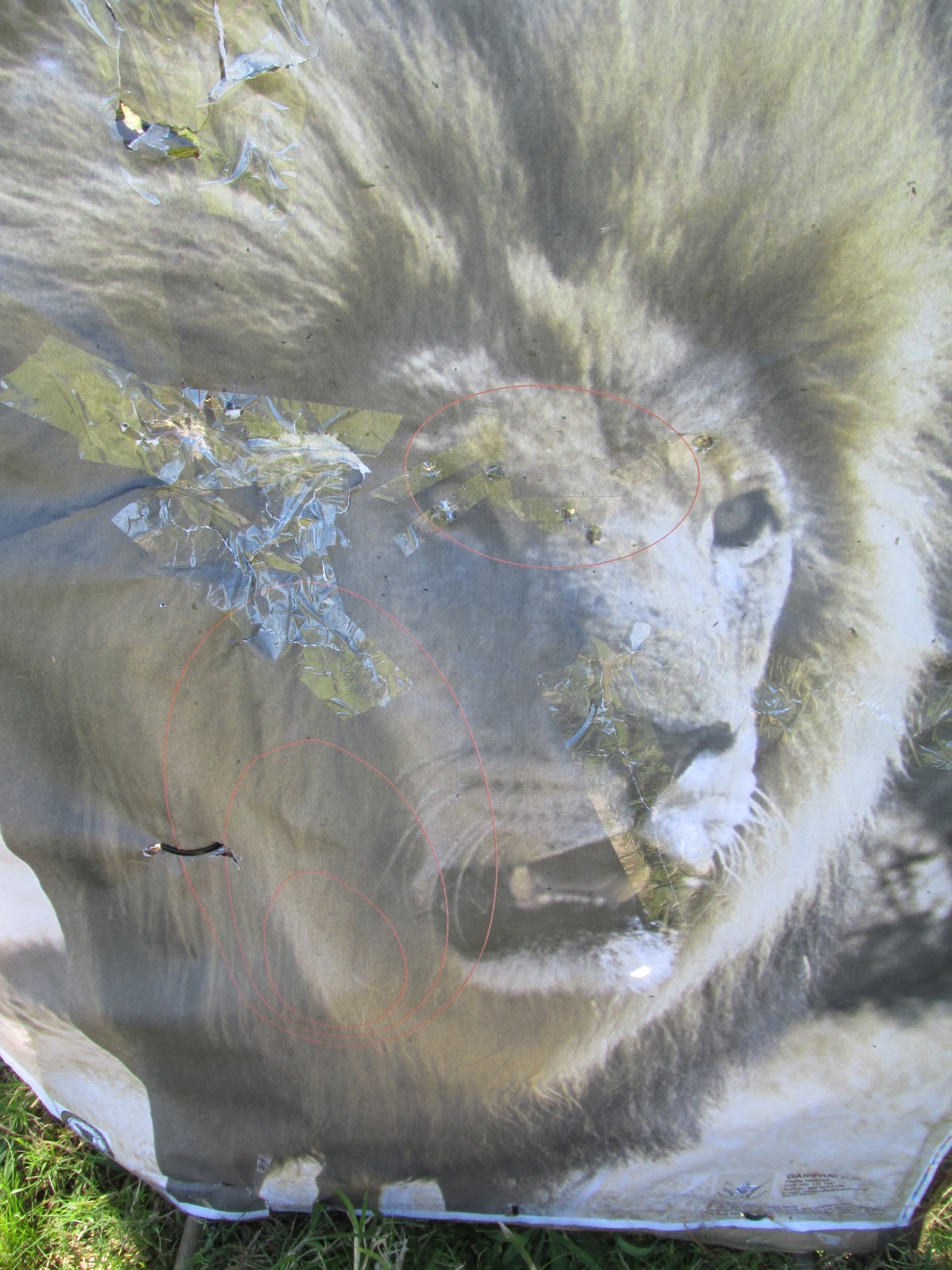
Other timed drills included shooting a poster of a charging buffalo in the brain (a very small red circle between the eyes), handling a misfire, and my favorite, reacting to a charging lion (a poster of a lion running at full speed – or as fast as my fellow student Lewis Buckner and future Game Ranger in the Masai Mara could run the line attached to the lion contraption) while on a simulated walk with guests. In this drill, the lion runs at you with the intent to tear you to shreds. You have to shout at the lion, cock your rifle, tell your guests to stay calm and not run, shout at the lion again, shoot the lion at 5 meters, fire an insurance shot, move to the lion and poke him in the eye to make sure he isn’t just pretending to be dead, reload, and ask your guests if they are all ok. I got the Lion-poster in his right eye with my first shot (In real life, you only have one chance to stop a charging lion). Lion down, no drama, no profanity - except for Scott who might have said “Holy poo-poo Tris! Good shot!”

This was all on Day One of our weeklong Advanced Rifle Handling practical assessment. By Day Three, I was in tears, so sore and bruised up and down my arm and on my breast that I bailed. I remembered that I don’t like guns and would not want to have to shoot an animal anyway, so I was okay with it. Some of the gents tried to encourage me to stick with it. When I said, “If firing a rifle caused pain, bruising and swelling on your nuts, would you keep at it?” and they winced in sympathy. Scott did spectacularly well up until day five, the day of the actual assessment when he impulsively chose a different rifle than the one he had been shooting spectacularly all week. Two weeks later he was re-assessed by James Steyn back in Klaserie and passed with flying colors.

“What does this all mean!” I hear you saying. Not much! Only that if we get the chance, we will do more courses like this in the future.

Scott and Tris
Raptor’s View
Hoedspruit South Africa


Next: “Whoopsie!” And Other South African Expressions